June 1, 2024 | Tawfiq Modeer[1]
You don’t need to be a seasoned political analyst to recognize that the global order is being reshaped. The multitude of discussions and the consensus among experts have moved past the question, “Is the global order changing?” to explore the political, social, cultural, and economic implications of that change. For us as economists and policymakers, the more pressing question is: What are the ramifications for economics, a discipline inextricably linked to politics? Does economics as a science and practice evolve? How?
The stagflation of the late 1970s was a catalyst for policymakers to embrace the neoliberal school of thought, championed by the U.S. President Ronald Reagan and British Prime Minister Margaret Thatcher. This school became the prevailing doctrine in economic thought and public policy across many countries. The 2008 financial crisis, however, shook the world and triggered a deluge of criticism against the neoliberal model. Critics pointed to its role in causing the crisis, exacerbating inequality, contributing to climate change, and failing to fulfill promises of widespread prosperity. The rise of behavioral economics further undermined a core tenet of neoliberalism: the assumption of “individual rationality,” which justifies market efficiency and cautions against government intervention except in the narrowest circumstances. Despite these challenges, neoliberalism has managed to retain its grip on public policy.
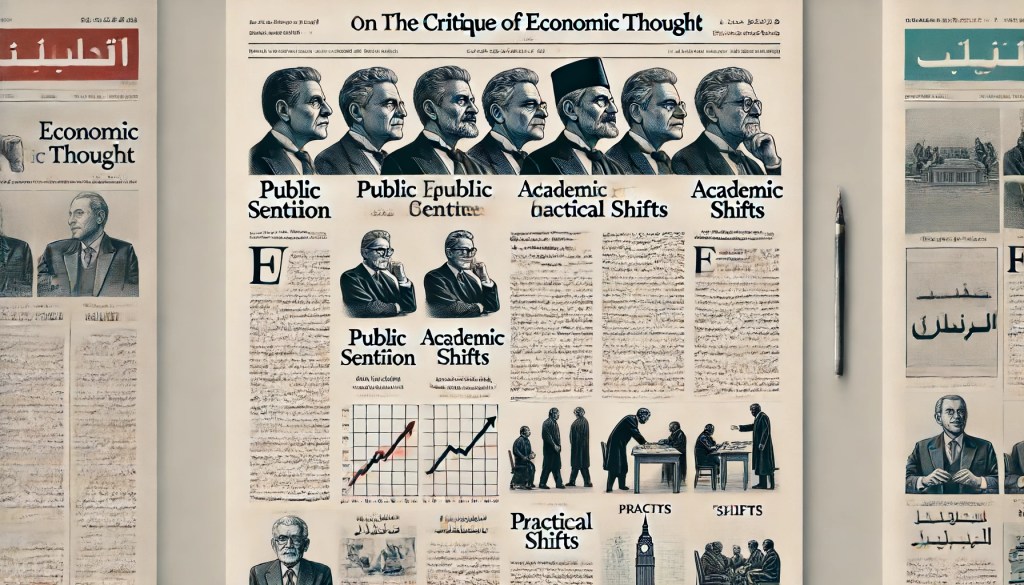
So, does history repeat itself, and will the return of inflation after the COVID crisis be the straw that breaks the back of neoliberalism and reshapes economics? To answer this question, bear with me and let’s briefly examine some indicators and their implications for the public, academic circles, and public policy:
Public Sentiment
Publicly, most Americans are frustrated with the economic situation. The Edelman Trust Barometer has recorded historically low levels of trust, with a majority of Americans believing that economic conditions will not improve in the next five years. Four out of five doubt that their children’s lives will be better than their own. The latest Pew Research Center polls reveal a decline in support for capitalism, especially among Democrats and young people. In fact, 58% of Democrats under 30 now have a “positive impression” of socialism, while only about 29% view capitalism favorably. Just days ago (May 24), a significant number of leading economists and prominent experts signed a petition titled “Winning People’s Trust,” calling on governments to play a larger role in the economy and move away from the sole reliance on “market efficiency.”[2]
Academic Discontent
Academically, the discontent with the mainstream is growing. This is evident in Nobel laureate Angus Deaton’s article “Rethinking Economics,” where he used strong language to critique the prevailing economic thought, describing the profession as “in some disarray.”in a state of chaos.” Deaton highlighted five main areas where mainstream theory has failed: ignoring power and strong relationships, neglecting ethics, an obsession with efficiencies, and an excessive focus on econometrics. He argued that “Historians, who understand about contingency and about multiple and multidirectional causality, often do a better job than economists of identifying important mechanisms that are plausible, interesting, and worth thinking about, even if they do not meet the inferential standards of contemporary applied economics.” Deaton’s article was published in the latest issue of the International Monetary Fund’s Finance & Development magazine, which also dedicated its title to discussing “Economics: How Should It Change?” This issue serves as a clear signal of the urgent need to reassess prevailing economic thought, with articles titled “Why Economics Needs to Change and How It Can,” “Renewing Economics,” and “A New Compass for Economics.”
Practical Shifts
Practically, the mere discussion of “industrial policies” was once taboo, seen as blatant government intervention that neoliberalism deemed dangerous, ineffective, and distorting resource allocation efficiency. Despite this, the resurgence of industrial policies today is concrete evidence of a shift away from free-market policies. Over 2,500 industrial policies were approved last year, nearly three times the number in 2019, primarily by the wealthiest and most advanced economies. These are the same economies that once criticized these policies, despite them being key to their own advancement, according to economist Ha-Joon Chang. Nobel laureate Joseph Stiglitz of Columbia University sees the industrial policy package approved by the United States last year as “no brainer … making up for lost time after its failed 40-year experiment with neoliberalism.“
How Should We Approach Economics?
To avoid falling into the bias of a “single school” again, we must—starting from education—adopt “economic thought pluralism” by reasoning and benefiting from the perspectives of different economic schools in public policy making and economic analysis, instead of merely following—under the pretext of countries’ experiences or experts’ opinions—policies that have not met the aspirations of their peoples, are doubted by their experts, and ignored by their policymakers. Moreover, policies should be regularly reviewed according to social, historical, and ethical contexts—especially those adopted under expired assumptions and intellectual biases.
The purpose of my article is not a polemic against one school of thought in favor of another, nor is it an endorsement of government intervention or industrial policies, crucial as those debates are. Instead, it is a clarion call to “rethinking of our vision of economics.” Despite its efforts to mimic the natural sciences, adopting their analytical tools and mathematical models, economics remains inherently a political and social science. We cannot simply copy and paste economic ideas and policies without a deep awareness of underlying ideologies, nor can we ignore the social dynamics that differentiate one society from another. To avoid the trap of a monolithic intellectual approach again, we must start with education and embrace a pluralism of economic thought. This means engaging with diverse economic schools and leveraging their perspectives in public policy and economic analysis, rather than blindly following policies based on dubious expert opinions or the so-called lessons of other countries. These policies have often failed to meet the aspirations of their people, are questioned by their own experts, and are ignored by their policymakers. Furthermore, economic policies must be continually reviewed and updated in light of social, historical, and ethical contexts. It is especially vital to challenge and discard those policies rooted in outdated assumptions and intellectual biases. Only then can we cultivate a truly dynamic and responsive economic science, one that is as attuned to the realities of human societies as it is to theoretical rigor.
[1] This is a translated version of the article published at the Saudi Economic Association magazine 2024Q2
[2] It is worth recalling the student protests at Harvard University in 2011 and the University of Manchester in 2014, among others. These students objected to the dissemination of a single ideological framework under the guise of economic science, criticizing the teaching of a “narrow and extremely limited” perspective. They called for the pluralism of economic thought and openness to disciplines like history, politics, and philosophy, instead of the dominance of the standard economic model that stifles “purposeful critical thinking.”
 tamodeer.com
أضف تعليق